 |
||
|
||
|
||
| Volumes: 1 2 3 4 5 6 7 8 Contents Exhortation previous next | ||

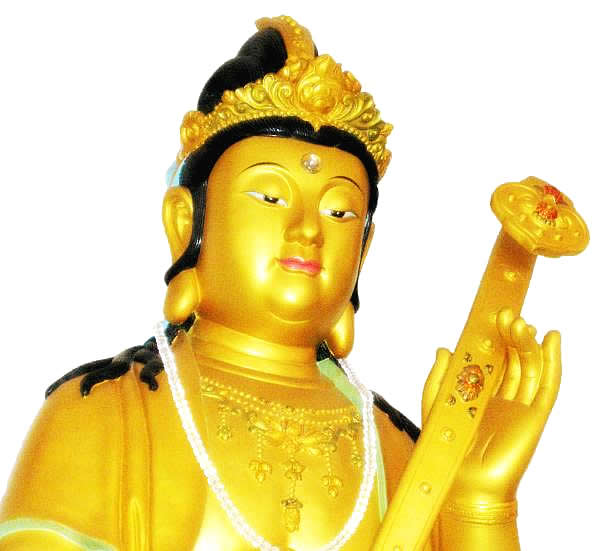
Manjushri Selects the Organ of Entry
VOLUME 5, Chapter 3
J3 The Buddha instructs Manjushri to select one.
K1 The Thus Come One instructs him to select.
L1 He first explains that all descriptions are equal.
Sutra:
Then the Thus Come One said to Dharma prince Manjushri, "You should now contemplate these twenty-five great Bodhisattvas and Arhats who are beyond learning. Each has explained the initial expedient in his accomplishment of the Way. All say they have cultivated to true and actual perfect penetration. Their cultivation is equal without distinctions of superior and inferior or earlier and later."
Commentary:
Then the Thus Come One, Shakyamuni, said to dharma prince Manjushri, "You should now contemplate these twenty-five great Bodhisattvas and Arhats who are beyond learning." Take a look now; reflect on the dharma-door which each of these twenty-five sages used. "Beyond learning" refers to those who have been certified to fourth-stage arhatship or above. Each has explained the initial expedient in his accomplishment of the Way. All say they have cultivated to true and actual perfect penetration. They attained genuine, perfect penetration of the sense-organs. Their cultivation is equal without distinctions of superior and inferior or earlier and later. In fact, there is no way to distinguish them as better or worse, excellent or deficient, or more or less advanced.
L2 His reason for asking him to select one.
Sutra:
I now wish to cause Ananda to become enlightened, and so I ask which of these twenty-five practices is appropriate to his faculties, and which will be, after my extinction, the easiest expedient door for living beings of this realm to enter in order to accomplish the Bodhisattva vehicle and seek the Unsurpassed Way.
Commentary:
Shakyamuni Buddha says: I now wish to cause Ananda to become enlightened. Ananda is still a first-stage arhat. I'd like him to become enlightened and attain the second, third, or fourth fruition of arhatship, and so I ask which of these twenty-five practices is appropriate to his faculties. Which one is right for someone with Ananda's abilities? There are eighteen realms and seven elements; which dharma-door is most appropriate for Ananda? And which will be, after my extinction, the easiest expedient door for living beings of this realm to enter in order to accomplish the Bodhisattva vehicle and seek the Unsurpassed Way.The living beings referred to here are us. We at the Buddhist Lecture hearing this dharma are just the ones he means. You who read this sutra now are also included. So don't set yourself apart and say, "I'm not included." You'll just mess yourself up that way. If you put yourself outside, you will fall in the future, and if you become a horse, cow, dog, chicken, or pig, it won't be easy to get to listen to the Shurangama Sutra. For one thing, you'd never make it up the four flights of stairs to the lecture hall! In Hong Kong, ducks came to listen to my sutra lectures, but that was on the ground floor.
Long ago, Shakyamuni Buddha arranged our seats in this dharma assembly that is now taking place. Don't take yourselves too lightly. Of course, if you don't come to listen now, you won't have a share. "Which of these dharma-doors will be found most expedient by living beings of the future who have great faculties and who in every thought seek the Unsurpassed Way?" the Buddha asks Manjushri Bodhisattva. "Which dharma-door will most easily bring success? Manjushri Bodhisattva, set your mind to it and select one."
K2 Manjushri responds with a verse.
L1 He prepares to speak the verse.
Sutra:
Dharma prince, Manjushri, receiving the Buddha's compassionate instruction, arose from his seat, bowed at the Buddha's feet, and, basing himself on the Buddha's awesome spirit, spoke verses to the Buddha.
Commentary:
Dharma prince, Manjushri, receiving the Buddha's compassionate instruction, arose from his seat. Wonderfully Lucky Bodhisattva was directed by the Buddha to select from any of the eighteen realms and seven elements a method of attaining perfect penetration. He was to find the one most appropriate for Ananda and for us to cultivate. The six sense-organs, the six sense objects, and the six consciousnesses make up the eighteen realms. Earth, wind, fire, and water, along with emptiness, consciousness, and perception are the seven elements, as was explained in detail previously.
Receiving this compassionate instruction from the Buddha, Manjushri Bodhisattva arose from his seat, bowed at the Buddha's feet, and, basing himself on the Buddha's awesome spirit, spoke verses to the Buddha. The Bodhisattvas and Arhats all have places to sit around the Buddha, unlike Fire-head Vajra, who must stand in the assembly. Verses can vary in number of feet and lines, but they all contain the principles of the sutra.
L2 He speaks the verse.
M1 He brings the source up to introduce his selection.
N1 He shows two sources.
Sutra:
The sea of enlightenment in nature is perfect and clear.
Complete, distinct Bodhi is a miraculous source.
But when basic brightness shone so that objects appeared,
With objects' existence, the nature's brilliance ceased.
Commentary:
The sea of enlightenment in nature is perfect and clear. The sea of enlightenment is boundless, containing within it all the mountains, rivers, and great earth, the vegetation and myriad appearances. The nature of the sea of enlightenment is both clean and perfect. Complete, distinct Bodhi is a miraculous source. The clarity of perfection of the sea of enlightenment is fundamentally subtle and wonderful. But within this subtlety of a single truth, falseness arises, and the light reveals the arising of objects. But when basic brightness shone so that objects appeared / With objects' existence, the nature's brilliance ceased. Basically, the sea of enlightenment contains everything within it. There is nothing which is not in the nature of the treasury of the Thus Come One. But as soon as there is a single ignorant thought, a falseness arises. Once there is falseness, there are objects, defiling appearances. Because of this falseness, the inherent light of the enlightened nature does not shine forth, just as when the sky is covered by clouds.
N2 He discusses production and extinction.
Sutra:
Confusion and falseness bring about emptiness.
Relying on emptiness, time and space take form.
Thoughts settle, making countries and lands.
What knows and feels becomes living beings.
Commentary:
Confusion and falseness bring about emptiness. Because of falseness, subject and object come into being. Basically, both aspects are false. In the substance of the sea of enlightenment not a single dharma stands. There isn't anything at all. But, "Staring produces the appearance of fatigue." After a sustained period of time, protraction brings about fatigue. And then a falseness and confusion give rise to emptiness. In the sea of enlightenment there isn't anything, not even emptiness. The verse says below:
The emptiness created within enlightenment
is like a single bubble in all the sea.
How insignificant that is! And yet, we think of emptiness as being so vast. Relying on emptiness, time and space take form. The ten directions and three periods of time come into being. Thoughts settle, making countries and lands. Once time and space arise out of emptiness, then false thinking becomes solid, making the lands. What knows and feels becomes living beings. Knowledge and sensations turn into living creatures.
Sutra:
The emptiness created within great enlightenment,
Is like a single bubble in all the sea.
Lands like fine dust motes, subject to outflows,
All come forth out of empty space.
Just as the bubble bursts, space is no longer there.
How much the less the three states of being!
Commentary:
The first lines of the verse said, "The sea of enlightenment in nature is perfect and clear / Complete, distinct Bodhi is a miraculous source." The perfection of the pure source of Bodhi is extremely wonderful. Now the verse speaks of the emptiness created within great enlightenment. We all are aware of the existence of emptiness, but do we know where it came from? I believe no one knows. That's because emptiness is so vast. It's impossible to know the limits of empty space or its source. Who is the mother of emptiness? No one knows. But now the Shurangama Sutra points to the source. Emptiness is born from the nature of great enlightenment. And yet within that expanse it is extremely minute. How big is it? It is like a single bubble in all the sea, like a little fleck of foam in the ocean.
Lands like fine dust motes, subject to outflows / All come forth out of empty space. There are three categories of outflows:
1. Outflows of desire;
2. Outflows of existence;
3. Outflows of ignorance.
Myriad lands which have outflows all come out of emptiness. The emptiness came out of enlightenment, and the lands came out of emptiness. Just as the bubble bursts, space is no longer there. In the same way that a bubble pops on the ocean, the emptiness disappears in the great enlightenment. How much the less the three states of being!
N3 He makes clear there must be a selection.
Sutra:
Returning to the source, the nature is not two.
Many are the entrances through expedients;
None of them does the sagely nature fail to go through.
Compliant or adverse, all is expedient.
First resolve and entering samadhi,
Come slow or fast as there are different norms.
Commentary:
In his verse, Manjushri Bodhisattva says that emptiness is like a bubble in the sea of enlightenment, and that countries and lands within the emptiness are also extremely minute. If emptiness disappears, all the countries and lands, the mountains, rivers, and the great earth, and the sentient and material worlds all disappear as well.
When one cultivates this dharma-door, returning to the source, the nature is not two. "Returning to the source" means accomplishing Buddhahood. There is only one place to return to, and that is your original home. This world we people live in is not really our home. "I have a home," you protest. But that house is not your genuine home. To become a Buddha is to find your genuine home. Before you become a Buddha, you are a vagabond moving from hotel to hotel. You are always on the move.
Many are the entrances through expedients. Being "expedient" means being unattached. For example, once there was a child crawling toward a well which was flush with the ground. If the child had continued, it would have fallen into the well. The Buddha saw this, but he knew that if he called the child back, it would not have listened, but would have continued to crawl forward. So he made a fist with one hand, held it out, and called, "Child, come back! I have candy in my hand for you! I have candy. Do you like candy?" When the child heard there was candy, it turned around and came back. There was no candy in the Buddha's hand after all. But was the Buddha lying? No. That is an example of an expedient method. He used his "empty fist to save the child" because there was no other method that would have worked at that point.The doors of expedients are uncountable. In general, whatever method will save a person is the dharma-door you use. None of them does the sagely nature fail to go through / Compliant or adverse, all is expedient. When you are certified to the dharma-nature of a sage, there is nothing you cannot understand. What is compliant is expedient, and what is adverse is also expedient. Whatever complies with your abilities and circumstances, you can use in your cultivation. What is "adverse" not in accord with your situation, can still be applied to your cultivation. Both the compliant situations and the adverse ones in which you cultivate are the expedient dharma-doors.
First resolve and entering samadhi / Come slow or fast as there are different norms. Some cultivate more quickly, some more slowly. So they can't all be lumped together.
M2 He examines each door.
N1 He examines the six defiling objects.
Sutra:
Form and thought combined become the 'dust.'
Their essence is not discernible.
How can one use what lacks clarity,
And expect to gain perfect penetration?
Commentary:
Form is created from false thinking. Form and thought combined become the 'dust', the defiling objects of form. Their essence is not discernible. It is not clear and comprehensible. How can one use what lacks clarity / And expect to gain perfect penetration? Can you expect to attain the dharma-door of perfect penetration with a method that is neither clear nor ultimate? That is impossible. The verse goes on to say that using the sense-object of form to cultivate perfect penetration is not the best method. Some people are able to be certified to the fruition through this method, but only because they have special conditions with that particular dharma-door. It is not something that most people can cultivate.Volume 5 pages: 1 2 3 4 5 6 7 8 9 10 11 12 13 14 15 16