 |
||
|
||
|
||
| Volumes: 1 2 3 4 5 6 7 8 Contents Exhortation previous next | ||
The Spiritual Mantra
VOLUME 6, Chapter 3
H2 On second request he speaks the spiritual mantra.
I1 The entire assembly asks again.
Sutra:
Ananda bowed at the Buddha's feet and said, "After I left the home-life, I relied on the Buddha's affectionate regard. Because I sought erudition, I still have not been certified to the unconditioned."
Commentary:
After Ananda heard this description by Shakyamuni Buddha, he bowed at the Buddha's feet and said, "After I left the homelife, I relied on the Buddha's affectionate regard. I counted on the Buddha's fondness for me, on his special affection. Because I sought erudition, I still have not been certified to the unconditioned. He was always concerned about being better than everyone else. "I wanted to surpass others," and so he had the idea, "You can't recite the sutra from memory, but I can. You can't even explain that sutra, and I remember every word of it." He was always competing to be number one. He decided to use erudition to obtain the first position. True enough, Ananda became foremost in learning, but he still did not certify to the unconditioned. He still had not reached to the fruition of sagehood that was unconditioned. He couldn't obtain the level beyond learning. This was of great harm to him.
Sutra:
When I encountered that Brahma Heaven mantra, I was captured by the deviant spell; though my mind was aware, I had no power to free myself. I had to rely on Manjushri Bodhisattva to liberate me. Although I was blessed by the Thus Come One's spiritual mantra of the Buddha's summit and imperceptibly received its strength, I still have not heard it myself.
Commentary:
"When I encountered that Brahma Heaven mantra, I was captured by the deviant spell; though my mind was aware, I had no power to free myself. I became confused by the deviant spell of the externalist way, by the deviant trick of a demonic dharma. I was physically captured by the spell; my body was confused by it, but my mind was still somewhat clear." His mind was not totally alert, but he wasn't totally muddled, either. He was in a daze, as if he were asleep, and yet he was awake. He was as if drunk, but he hadn't taken anything intoxicating. But the effect was much the same as with drink.When you ask a person who's recovered from a drunken binge what he did while under the influence, he will remember some things and forget others. That's the state Ananda was in. Or he was like a person who is about to drift off to sleep; he isn't quite asleep, and yet he has a dream, or what seems to be a dream. He had no power to free himself. It's like encountering a demonic ghost while you are asleep at night, such as a kumbhanda ghost, which uses a demonic spell to paralyze you. When that happens, you may wake up and stare, but you cannot move. You are held by the demonic power of the ghost. That's what Ananda experienced. Although he was conscious, he was not in control of himself. He could not get free. "I had to rely on Manjushri Bodhisattva to liberate me. The Buddha commanded Manjushri Bodhisattva to come and save me. I depended on the Buddha to have Manjushri Bodhisattva rescue me. He freed me.
"Although I was blessed by the Thus Come One's spiritual mantra of the Buddha's summit and imperceptibly received its strength, I still have not heard it myself. The World Honored One, the Thus Come One, the Buddha, used the spiritual mantra spoken by the transformation Buddha atop the Buddha's summit. And when Manjushri Bodhisattva came to where I was and recited the mantra, I received the benefit invisibly." That means that when Manjushri Bodhisattva got there, he didn't chant the mantra in a loud voice; he merely had to recite it silently to free Ananda. It's all right to recite the mantra loudly when you are before the Buddhas in the temple, but when you are out at other places, you can recite it silently and it is just as effective. If you got out on the streets and start bellowing, "Na Mwo Sa Dan Two Su Chye Dwo Ye!" people are going to think you are crazy. You needn't be attached to some particular ritual and thereby cause people to slander the dharma, which is what they would be doing if they said you were crazy. When they commit slander, they commit offenses. You don't want to say, "If he commits offenses, that's his problem. I'll recite even louder and let him slander even more so that he commits even greater offenses, and he will surely fall into the hells." If you have that kind of attitude and intentionally cause people to commit offenses so that they fall into the hells, then you shouldn't even study the Buddhadharma.
People who study the Buddhadharma are sympathetic and compassionate toward others. Their attitude is to do nothing that would cause anyone else to fall into the hells, even to the point that they would rather go to the hells themselves than cause anyone else to go. That's the way you should be. You cannot think, "He slandered me, let him fall into the hells." Or, "If I have a run-in with someone, I will go after them and recite the Shurangama Mantra, and then when they slander me they will fall into the hells." If you have that kind of thought, then you'd better stop reciting the Shurangama Mantra right this minute and leave off your study of the Buddhadharma. That's because people who study the Buddhadharma must not hate people, must not be jealous of people, must not obstruct people, must not be selfish in these ways. One cannot have the attitude, "I'm fine, to heck with you." The Buddhadharma exists for the sake of rescuing all living beings. It is not designed to cause living beings to commit offenses. You must be clear about this point.
Ananda says, "I imperceptibly received its strength, but I still haven't actually heard it. I got the strength from it, but silently and invisibly. So I've never actually heard it. Although I received the benefit of it, I still don't even know how to recite it. I've never even heard it!"
Sutra:
I only hope that the greatly compassionate one will proclaim it again to kindly rescue all the cultivators in this assembly and those of the future who undergo the turning wheel, so that they may become liberated in body and mind by relying on the Buddha’s secret sounds.
Commentary:
I only hope that the World Honored One, the Greatly Compassionate One will proclaim it again. My one wish is that the Buddha would speak it again so that I can hear it and also to kindly rescue all the cultivators in this assembly. Please speak it also to rescue those of the future who undergo the turning wheel of the six paths, so that they may become liberated in body and mind by relying on the Buddha's secret sounds. Based on the Buddha's secret syllables, they will become free. They will not be upside down or confused.
We recite the Shurangama Mantra every day just to help people stop being upside down and confused and to help them stay away from doing things which they clearly know are wrong. For instance, one knows that taking opium is wrong, that it wastes time and dissipates one's energy, yet, one still insists on smoking it. Clearly knowing that the use of marijuana is a violation of the law, still one "must" try it out. Well aware that killing is not right, one still takes the lives of living beings. Knowing without a doubt that indulging in sexual misconduct is not right, one conducts oneself in this way nonetheless. Knowing full well that it is wrong to steal, one spends all day and night taking things from other people, if it's not a car, it's a tape-recorder or a radio. A thief knows full well he is breaking the law, and that if he is caught the police will take him to jail, but still he goes and does it. That's "doing things which they clearly know are wrong."
Sutra:
At that moment, everyone in the great assembly bowed as one and stood waiting to hear the Thus Come One's secret divisions and phrases.
Commentary:
At that moment, everyone in the great assembly, the huge multitude of beings in that gathering, bowed as one and stood waiting to hear the Thus Come One's secret divisions and phrases. They all bowed together to the Buddha and then stood on tiptoe waiting for the Buddha to speak the secret sections and divisions of the mantra. "Divisions" refers to the five major sections of the mantra. The "phrases" are smaller parts consisting of several lines each, such as "Na Mwo Sa Dan Two / Su Chye Dwo Ye / E La He Di / San Myau San Pu Two Sye." But these divisions and phrases are secret, that is, they are not easy for people to understand. They are "secret" in the sense that people do not share a common knowledge about them. When you recite them, you do not know what advantages you obtain. I do not know what advantages I obtain. Although benefit is obtained, there is no mutual awareness of it among those benefited, nor is there a common understanding of the mantra itself.
I2 The Thus Come One answers again.
J1 He speaks the spiritual mantra.
K1 An appearance of light.
Sutra:
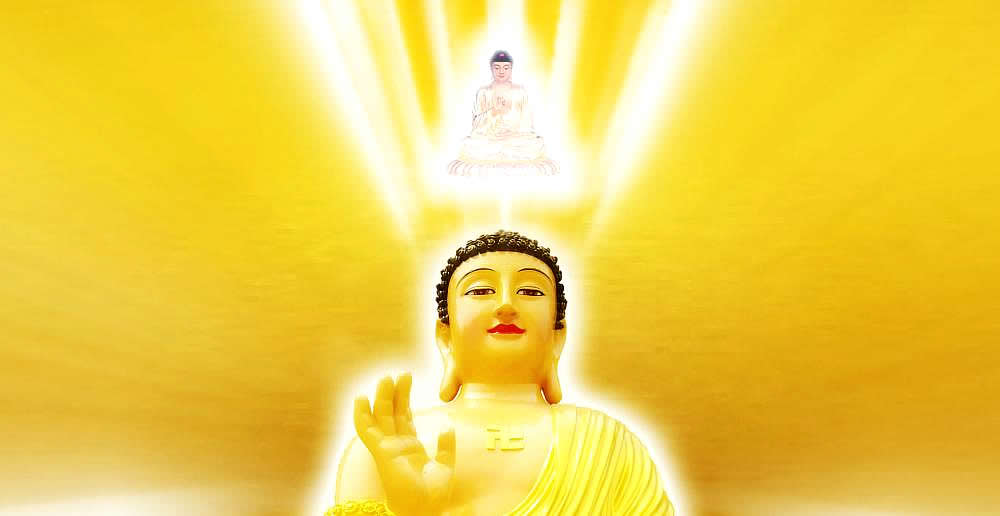
At that time, a hundred brilliant rays sprang from the mound of the flesh on the crown of the World Honored One's head. A thousand-petalled precious lotus arose from amidst those rays. Upon the precious flower sat the Thus Come One's transformation.
Commentary:
At that time, a hundred brilliant rays sprang from the mound of the flesh on the crown of the World Honored One's, Shakyamuni Buddha's, head. A thousand-petalled precious lotus arose from amidst those rays. Upon the precious flower sat the Thus Come One's transformation. A transformation body of the Buddha sat upon the thousand-petalled precious lotus in the midst of the hundred rays of light.
Sutra:
From the crown of that Buddha’s head, in turn, ten beams of light shone forth, each composed of a hundred rays of precious light. Every one of those glowing rays shone on lands as many as the sands of ten Ganges Rivers, while throughout empty space there were Vajra Secret Traces spirits, each holding aloft a mountain and wielding a pestle.
Commentary:
From the crown of that Buddha’s head, in turn, ten beams of light shone forth, each composed of a hundred rays of precious light. "Crown" here refers to the crown of the head of the Thus Come One's transformation. Another ten beams of light issued forth out the top of the head of the transformation-body Buddha. Every one of those glowing rays shone on lands as many as the sands of ten Ganges Rivers.These rays of light shone everywhere, on countless countries, while throughout empty space there were Vajra Secret Traces spirits, each holding aloft a mountain and wielding a pestle. At the same time that the light shone forth, the Vajra Secret Traces dharma protectors held mountains in their bare hands and brandished pestles, like the one Wei Tuo Bodhisattva wields. They were all over the place, filling up all of empty space.
K2 The great assembly respectfully listens.
Sutra:
The great assembly, gazing upward, felt fearful admiration and sought the Buddha's kind protection. Single-mindedly they listened as the Thus Come One in the light at the invisible appearance on the crown of the Buddha’s head proclaimed the spiritual mantra:
Commentary:
The great assembly, gazing upward, felt fearful admiration and sought the Buddha's kind protection. All the great Bodhisattvas, great Arhats, great bhikshus, and all the others in the great gathering, threw back their heads and looked up toward the transformation- body of the Thus Come One atop the crown of the Buddha's head. Some felt fearful when they saw the transformation Buddha. But at the same time, they admired that Thus Come One. They loved him, but not with the emotional love that exists between men and women. What they felt was true love, free of desire or longing. They had both these feelings at the same time, they were awestruck and yet drawn by love. So they hoped the Buddha would take pity on them and also protect them. Single-mindedly they listened as the Thus Come One in the light at the invisible appearance on the crown of the Buddha's head proclaimed the spiritual mantra. They were all of one mind. They all wanted to listen to the Buddha. The mound of flesh on the crown of the Buddha's head is called the "invisible appearance on the crown." It is called the "invisible appearance" because ordinary people cannot see it. Those who saw the hundred rays of light and the transformation Buddha atop the crown of the Buddha's head were sages who had been certified to the fruition. The transformation Buddha that was emitted from the invisible appearance on the crown hovered in space and proclaimed the spiritual mantra.
So, the Shurangama Mantra was not spoken by Shakyamuni Buddha himself in the flesh, but rather it was proclaimed by the transformation-body Buddha he sent out into empty space. As to the mantra, no one understands it. Nor is it possible to explain it syllable by syllable and line by line. But if you want to understand it, I can try to explain it for you. However, this is not the time for that, because we are in the middle of the explanation of the Shurangama Sutra, and the mantra alone couldn't be completely explained in a year, or even in three years, or even ten years. So, at this point it cannot be explained thoroughly. I will simply explain the general meaning of the mantra.
The mantra has five divisions which correspond to the five directions : north, south, east, west, and the middle. The eastern division is the Vajra division, with Akshobhya Buddha as the teaching host. The southern division is the Production-of-Jewels division, with Production-of-Jewels Buddha as the teaching host. The central division is the Buddha division, with Shakyamuni Buddha as the teaching host. The western division is the Lotus division, with Amitabha Buddha as the teaching host. The northern division is the Karma division, with Accomplishment Buddha as the teaching host. There are five divisions, because there are five huge demonic armies in this world. There are demons to the east, south, west, north, and in the center. Since there are these five demon armies, not just five demons, the Buddhas also cover the five directions to suppress the demons. If there were no Buddhas, the demons could appear openly in the world.
Within the five divisions of the mantra there are, in general, more than thirty dharmas, and it has more than a hundred dharmas that can be discussed in detail. There are five major kinds of dharmas:
1) Dharmas of accomplishment. This means that with this dharma, you will be successful in what you seek or in what you vow or wish for.
2) Dharmas of increasing benefit. This means that when you recite this mantra, you can increase benefits which you yourself seek and you can also increase benefits for other people.
3) Dharmas of hooking and summoning. This means, literally, to "hook in" and catch and to call with a command all the weird beings, demons, and ghosts. No matter how far away they might be from you, you can bring them in and capture them. For instance, suppose one of them is harming someone, and when they finish they run away. If one knows how to use the dharma of hooking and summoning, then no matter how far that being may have run, you can arrest him.
4) Dharmas of subduing. Demons also have spiritual penetrations and mantras which they use. When you recite your mantras, they recite their mantras. But if you can use the Shurangama Mantra, you can smash through all their mantras. I've told you before about the section of the mantra which is for smashing the demon kings. It also is effective in destroying their mantras and spells. Although I've taught you this already, it bears repeating here. Those who have not studied this yet can take note of it. Why was it that as soon as the Shurangama Mantra was recited the former Brahma Heaven mantra lost its effectiveness? It was because of the "Five Great Heart Mantras."
Chr Two Ni
E Jya La
Mi Li Ju
Bwo Li Dan La Ye
Ning Jye Li
These five lines are called the "Five Great Heart Mantras." It is the fundamental mantra for destroying the mantras and spells of the heavenly demons and adherents of externalist ways. It doesn't matter what kind of mantra they come up with; you can destroy it with this one. Their mantras will lose their effectiveness. This dharma I've just transmitted could sell for several million dollars, but I do not sell it. Seeing that you have a certain amount of sincerity, I transmit it to you absolutely free.
5) Dharmas of dispelling disasters. Whatever calamity is due to occur can be prevented. For instance, suppose a person was due to fall into the sea and drown, but by reciting the Shurangama Mantra, he avoids the catastrophe. He might fall into the sea, but he doesn't drown. Perhaps you are in a boat that ought to sink, but you recite this mantra and the boat does not go down. Maybe you're in an airplane that is destined to crash, but you recite the Shurangama Mantra and the plane lands without incident. I'll tell you something incredible. I was going from Burma to Thailand, an air route that is particularly dangerous. But during that trip, the plane didn't show the effects of any turbulence. The ride was absolutely smooth. Even the pilot commented, "Why has it been such smooth going on this trip?" He had no idea that during that ride the gods, dragons, and the rest of the eightfold division, as well as Buddhas and Bodhisattvas, were on all sides of the airplane guarding and protecting it.That's the way the dharma of dispelling disasters works. When there clearly should be an accident, it can change big disasters to small ones and make small ones never even happen. Usually what happens is there's "alarm but no danger" if you recite the Shurangama Mantra.
In general, the mantra contains dharmas of auspiciousness. This means that when you recite the Shurangama Mantra, everything goes just as you'd like it to. It's really lucky and extremely auspicious.
The advantages of the mantra are so many that one could not even begin to express them in several years time. But at this time, I'll limit my explanation to these few dharmas and meanings.Volume 6 pages: 1 2 3 4 5 6 7 8 9 10 11 12 13 14