Sincerity Is All You Need
A Talk given by Shramanerika Jin Huan on February 6, 2026
All Buddhas, bodhisattvas, Venerable Master, Dharma Masters, and all Good and Wise Advisors, Amitabha! Tonight is Shramanerika Jin Huan’s turn to tie Dharma affinity with everyone. I would like to share my reflections on the recitation of the Amitabha Session. If I say anything that is not in accordance with the dharma, please be compassionate and correct me.
This year marks my fifteenth year participating in the Amitabha Session at the City of Ten Thousand Buddhas (CTTB). I feel profoundly blessed. This session has not only deeply connected me to CTTB but has also transformed my life, guiding me to become a better person and opening a path to explore the Buddha Dharma more deeply.
Reciting the Buddha’s name is among the first and remains my favorite Dharma door. I was drawn to its simplicity—it can be practiced while walking, standing, sitting, or lying down. I began reciting “Amitabha” even before I fully understood who the Buddha was, taught by my mother that it would lead to rebirth in the Pure Land. For decades, I recited with a simple, perhaps ignorant, faith, believing that only the reciter themselves would attain this rebirth.
It was not until I came to CTTB and encountered the Amitabha Sutra that I realized how truly wonderful and inconceivable this practice is. The Buddha taught that sincere mindfulness of the Buddha not only ensures rebirth in the Pure Land but also brings immense benefits in this very life and in lives to come. These benefits include: Amitabha residing above the reciter's head, protection from all Buddhas and Bodhisattvas, the guardianship of sacred beings, the elimination of karmic obstacles, an increase in blessings and wisdom, the avoidance of calamities, health and longevity, a peaceful death, and ultimately, the end of the cycle of rebirth and the attainment of Buddhahood.
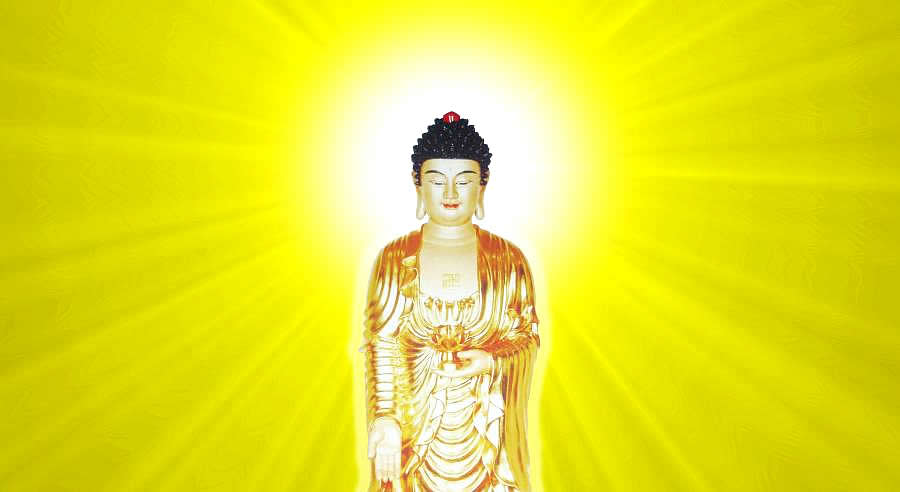
In my own life, reciting the Buddha’s name brings me happiness, safety, and a sense of protection. I wield it as a great spiritual weapon, turning to it in times of danger, difficulty, and even within troubled dreams, from which I have often awakened by invoking Amitabha’s name. Now, living at CTTB, “Amitabha” has become my greeting and my response—a constant thread woven into daily life.
Although I could not participate fully in this year’s session due to obstacles, the experience became a profound teacher. At the outset, I struggled with sitting due to leg swelling; after mere minutes, numbness and pain would arise, agitating my body and mind. I found I could not concentrate. My mouth recited, but my mind was scattered, beset by false thoughts. I felt exhausted and discouraged.
This struggle led me to reflect: Why was my mind so scattered? I realized several key reasons:
First, the body affects the mind. My posture was poor—a hunched back and tense shoulders created physical discomfort that disturbed mental peace. I learned to adjust: sitting with a straight yet relaxed back, opening the chest slightly, placing hands gently together, and reciting just loud enough for my own ears to hear.Second, my mind was too intense. Clinging to worries, attachments, and unchecked wandering thoughts made it impossible to gather my scattered mind. Before reciting, I now take a deep breath, exhale slowly, and silently set an intention: “Everything can wait. Right now, there is only me and the Buddha.”
Third, I learned to listen to my own recitation. Whether reciting aloud or silently, I focus on hearing the sound of the Buddha’s name. The ears hear, the mouth recites, and the mind contemplates the Buddha. When wandering thoughts arise, I simply notice them and gently return to the recitation, without resistance.
Through this reflection, I made a pivotal discovery. Reciting in a state of rush, expectation, or fear only breeds fatigue. But reciting with ease, an open heart, and a peaceful feeling transforms the practice into a “cool stream flowing in the mind.” The more I recite this way, the lighter, deeper, and more joyful it becomes. The mind, enjoying itself, no longer wishes to run away. I also came to see the value in noticing the mind’s scattering. It reveals our need to cultivate, shows us our karma being purified, and offers the chance for transformation. Each time we return from a wandering thought to the Buddha’s name, we experience a moment of lost mindfulness followed by a moment of awakening.
However, for practice to become strong, recitation alone is not enough. We must live in accordance with the Dharma. If our daily life is filled with anger, irritation, and affliction, the mind cannot find peace. Buddha recitation is not confined to the altar; it extends to every action, thought, and word. To recite without scattering, we must live lightly—knowing how to let go, forgive, and yield. A light mind leads to light recitation; a peaceful mind leads to peaceful recitation.
Thus, now, in the Dharma-ending age, recitation of the Buddha’s name is a most important Dharma-door. It is the most profound and fastest way to attain Buddhahood, with such great vow from Amitabha Buddha, “After I become a Buddha, if beings throughout the ten directions who recite my name, Amitabha Buddha, are not received and led to my land, I will not attain the Right Enlightenment.”
Our ultimate goal of reciting Amitabha is to seek rebirth in the Pure Land. Buddha recitation is a Dharma door, both easy and difficult. It is easy because anyone, anywhere, in any condition, can do it. It is difficult because to recite a single phrase with pure, undivided focus is a great achievement. Our mind is like a monkey, constantly swinging from branch to branch. We cannot force it to be still, but we can train it with consistent, daily practice. As the Venerable Master taught, reciting daily sows the seeds of Buddhahood in our mind-field. This daily practice builds a habitual power so that at the moment of death, the mind naturally turns to Amitabha, leading to a peaceful rebirth.
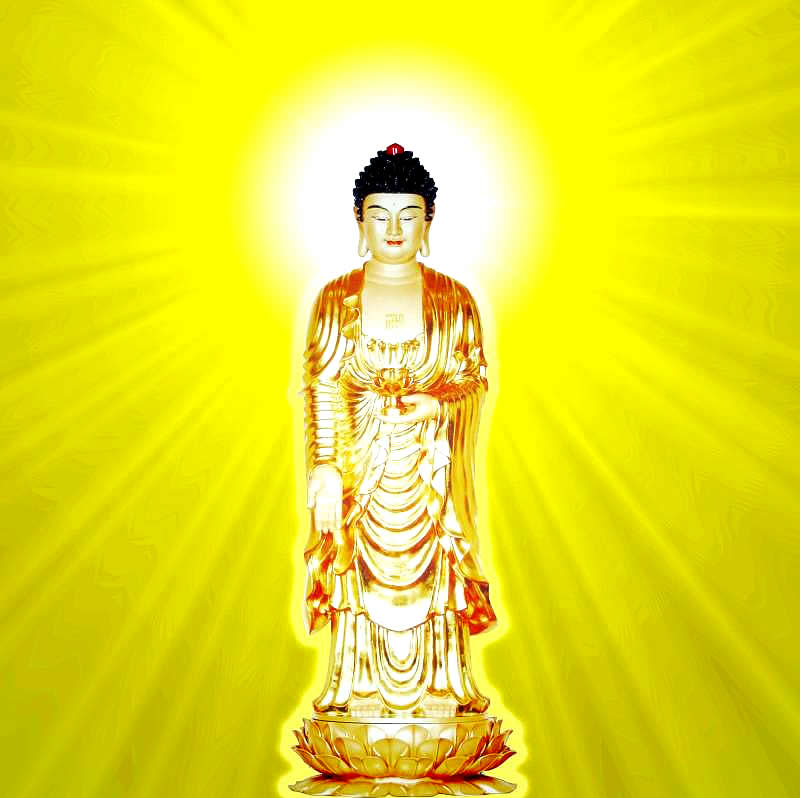
The power of sincere Buddha recitation is a boundless Dharma door, accessible to all. The following stories—one of a poor novice, the other of a worldly old man—beautifully illustrate how a sincere heart and steadfast practice can lead to the ultimate peace of the Pure Land.
I. The Sincere Novice
In Binh Dinh province, there was a young man from an impoverished family. Unable to attend school, he remained illiterate. At the age of fourteen, seeking a better life, he entered a temple and became a novice monk. The abbot gave him the name Dieu Man. Filled with humility, Novice Dieu Man approached the abbot. “Venerable Abbot,” he said, “I am ignorant and cannot read. How can I practice the Dharma?”The abbot smiled gently. “A sincere heart is the only requirement,” he replied. “If you cannot read sutras, then simply recite the name of Amitabha Buddha. Recite it while walking, standing, sitting, or lying down. Do not let your mind wander. Dedicate the merit to rebirth in the Western Pure Land, a world of ultimate peace and bliss described by the Buddha.”
Novice Dieu Man took these words to heart. He became known for his diligent service and gentle character, all the while holding faithfully to the Buddha's name.
One morning, during breakfast, he approached the abbot. “Today is Amitabha Buddha's birthday,” he said with a bow. “I wish to follow him to the Pure Land. Please grant me your blessing.”
Thinking the young novice was speaking from naïve enthusiasm, the abbot chuckled warmly. “That is a very good wish,” he said. "But why not wait until the 23rd of the twelfth lunar month? On that day, we sent the Kitchen God to heaven. You may go then."
The abbot meant this as a kind joke, but Novice Dieu Man received it as a sacred instruction. “Yes, Venerable Abbot. I will wait until the 23rd,” he replied solemnly.
When that day arrived, the temple was busy with rituals. Novice Dieu Man completed all his morning chores with extra care, filling the water jars and tidying the grounds. Then, he went to the small woodshed in the garden. He cleaned the space, sat down, and began his final recitation.
At lunch, his absence was noted. When he did not respond to calls, the abbot, remembering their conversation, grew concerned. The monks searched the garden and finally opened the woodshed.
A wondrous, sweet fragrance greeted them, though no incense burned. Inside, they found Novice Dieu Man. He sat in perfect meditation, wearing his robes, his prayer beads in hand. He had attained rebirth in the Pure Land, his simple, unwavering faith yielding the most profound fruit.II. The Old Man Who Was Paid to Recite
In Saigon, a lay disciple came to Venerable Thien Hoa with a problem. His elderly father, though financially secure, insisted on riding his bicycle to the market daily to sell small goods. “I tell him to rest and recite the Buddha's name at home,” the son said, "but he always replies, ‘Does reciting bring money?’”Venerable Thien Hoa saw an opportunity for skillful means. “Your father values money,” he said. “Then let us use money to guide him. I will pay him to recite.”
The plan was set. The son would provide the funds, and the Venerable Master would give the old man a wage for every rosary of Buddha's name he recited. Delighted by this “business opportunity,” the old man agreed. He began reciting diligently, keeping a careful notebook of his daily count to collect his payment each week.
For the first month, his motivation was purely to earn money. He would laugh, saying, “This is wonderful work! No rain, no sun, just sitting and earning money!” But the constant recitation began to work on his heart. Within a month, a change occurred.
When he next went to collect his wage, he refused it. “Venerable Master,” he said, “this money belongs to the people. Now, I recite as an offering to you.” His son's worldly scheme had succeeded; the old man's heart had been transformed by the practice itself. He continued reciting with sincere devotion for two years.
One day, three months in advance, he wrote a specific date and time on his grandson's study blackboard. When that day arrived, he instructed his family to clean the house and prepare the ancestral altar. He bathed in scented water, dressed in clean clothes, and paid solemn respects before the Buddha and his ancestors. Then, he sat down to recite.
When his family called him for the evening meal, he did not answer. They found him seated peacefully, having passed away at the exact foretold hour. He had achieved a conscious and tranquil departure, his earlier attachment to money completely purified by the power of the name he had learned to cherish.
A Single Dharma Door
These two stories, though different in their beginnings, converge in the same glorious end. They demonstrate that the practice of Buddha recitation requires neither scholarly knowledge nor perfect initial faith. It requires only a sincere engagement—a heart that takes the first step, whether from pure devotion like Novice Dieu Man or through a worldly expedient like the old man.By holding steadfastly to “Amitabha Buddha,” the mind is purified, the heart is transformed, and the path to the Western Pure Land becomes clear and attainable for all.
Years on this path, I understand that my journey, with its struggles and insights, is part of this same profound process. Each moment of a scattered mind is an opportunity to return. Each obstacle is a teacher.
By reciting daily, living the Dharma, and entrusting myself to Amitabha’s vow, I walk the path laid down by the Buddha, the Venerable Master, and countless sincere practitioners before me—a path that leads, step by step and recitation by recitation, from a scattered mind to a peaceful heart, and ultimately, home to the Pure Land.